
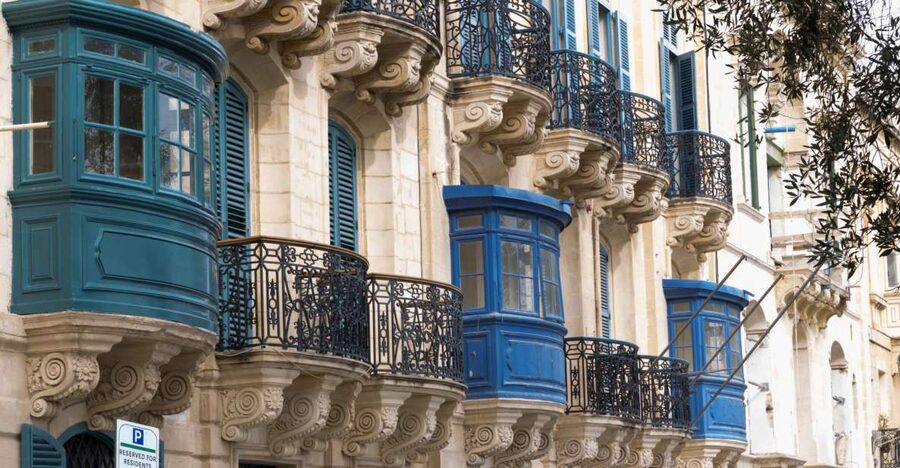
Reviewed · WALKING TOURS IN VALLETTA
Valletta Private Walking Tour
Valletta is small enough to cross on foot, but its streets are packed with churches, palaces, monuments, and stories. This private walk gives you a clear route through the fortified city, from the modern Parliament entrance to the views at Lower Barrakka Gardens, while connecting the sights to the Knights of St John, wartime Malta, and daily life in the old city. Guides such as Mario, Ian, Matthew, and Carmel bring strong teaching skills and plenty of local context.
I like the private format, which lets your guide adjust the pace, pause for photos, or change the route. I also like the mix of major sights and lesser-known details, including life in the Holy Infirmary, service as a galley slave, and the less-than-perfect conduct of some knights. The main drawback is price: at $362.95 for up to four people, it is fair for a full group but expensive for one person, especially since admission to several interiors is not included.
Key points to know before you book
- A three-hour introduction to Valletta: You cover the main central sights without spending a full day on a formal city tour.
- Private attention for up to four people: Your guide can respond to your interests and adjust the pace more easily than on a group walk.
- Strong history focus: Expect stories about the Knights of St John, the Great Siege, World War II, and modern Malta.
- Two Barrakka Gardens stops: Upper Barrakka offers Grand Harbour views, while Lower Barrakka provides a quieter finish near the city walls.
- Some admission fees are extra: St John’s Co-Cathedral, Grand Master’s Palace, and the museum at Auberge d’Italie are not included.
- Best value with three or four people: The group price works out to about $91 per person for four, but the cost is much harder to justify alone.
Starting beside Parliament and the Royal Opera House
The walk begins at the New Parliament Building on Republic Street, a useful meeting point at Valletta’s main entrance. You start with a striking contrast: modern stone architecture beside the remains of the Royal Opera House, damaged during World War II and later left as an open-air ruin.
Your guide uses these first stops to explain how Valletta was planned as a fortress city in the 1500s. The opening section is short, but it gives you the basic map of the city and explains why such a compact place carries so much political and military weight.
At Our Lady of Victories Church, the focus shifts to Malta’s early years under the Knights of St John. You hear about the figure associated with the church and the role the building played in the city’s first development. This is not a long interior visit, so the value comes mainly from the explanation and the setting.
More Walking Tours in Valletta
- The Original Valletta Walking Tour
★ 5.0 · 2,719 reviews - Valletta: 3-Hour Walking Tour
★ 4.7 · 1,605 reviews - Valletta: Guided City Walking Tour
★ 4.8 · 1,256 reviews
Il-Berga ta’ Kastilja and the city’s grand façades
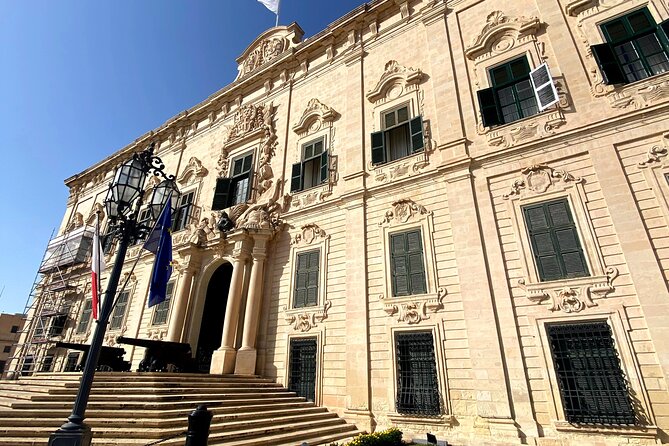
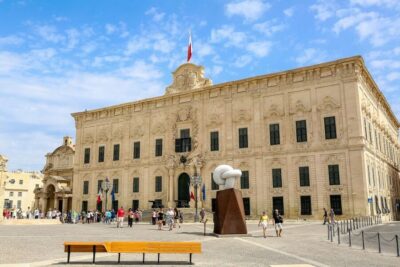
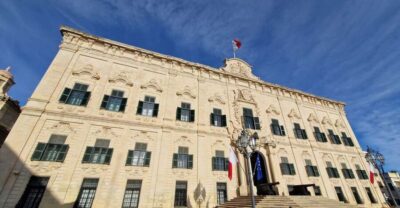
From there, the route reaches Il-Berga ta’ Kastilja, better known as the Auberge de Castille. Its large façade is one of Valletta’s most imposing sights. The building was linked to the Knights of St John and remains an important symbol of Maltese government.
This is a good place to listen rather than rush. Valletta’s buildings can look alike at first glance, especially when you are moving quickly along Republic Street. A guide helps you notice the purpose behind each auberge and explains how the different groups within the Order used these grand residences.
You will also pass Auberge d’Italie, now associated with the National Museum of Fine Arts. The tour does not include admission, so you can only enter if you pay separately and have enough time. That is useful to know in advance. The walking tour gives you an orientation, but it is not designed as a full museum visit.
Upper Barrakka Gardens and the Grand Harbour view
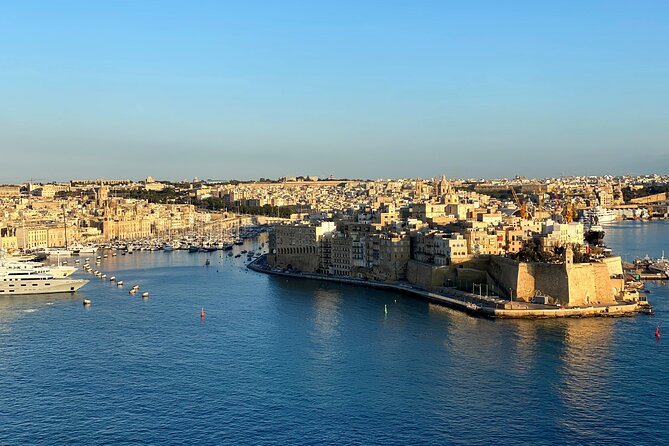
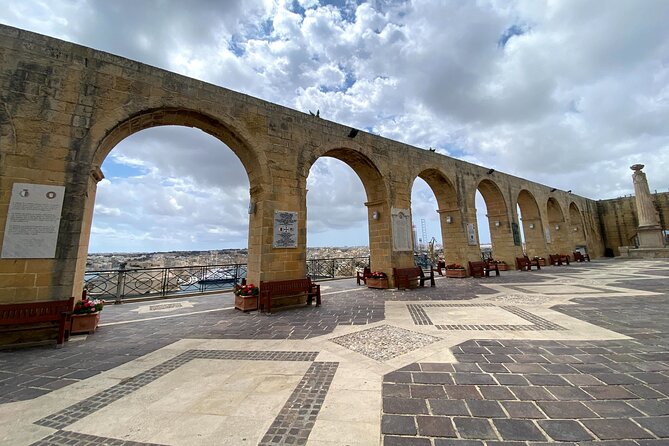
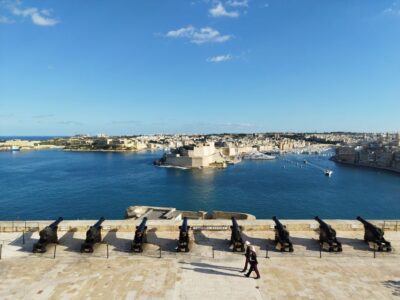
The Upper Barrakka Gardens are one of the tour’s best pauses. From the terrace, you look across the Grand Harbour toward the Three Cities and the water routes that helped make Malta such an important military base.
The itinerary allows about 30 minutes here, longer than at most other stops. That makes sense. You need time for photographs, a look at the harbour, and a chance to absorb the scale of the fortifications. The gardens also provide a break from the narrow streets and stone walls.
This is one spot where a private tour can feel more personal. You can ask your guide to point out harbour landmarks or explain the Great Siege and later military events. The exact amount of detail will depend on your guide, but the format gives you room to ask instead of simply following a fixed speech.
The gardens are also a sensible place to discuss the practical side of Valletta. Several people have found their guide’s suggestions for restaurants, sights, and the rest of their Malta visit helpful. Guides such as Ian and Mario have been praised for offering advice beyond the formal route, which can be especially useful if this is your first morning in the country.
St John’s Co-Cathedral and the art inside
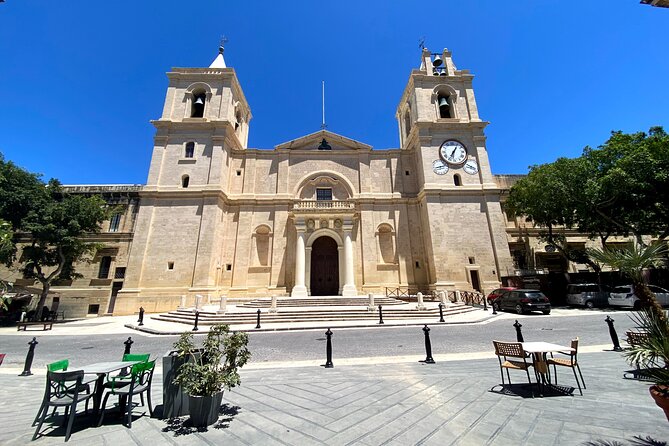
St John’s Co-Cathedral is one of the key sights on the route, but its admission fee is not included. You should confirm the current entry cost when booking or before arrival, especially if your group is watching its budget.
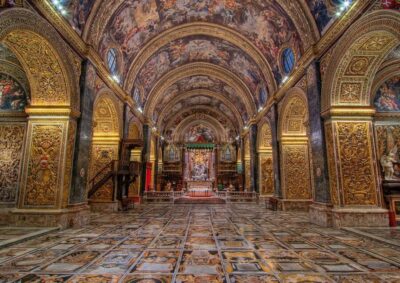
Inside, the focus is on the artists and works connected to the cathedral. The interior is far more elaborate than its plain exterior suggests, and a guide adds context to the paintings, chapels, and decoration. Several guides, including Jennifer and Mario, are praised for making the cathedral and its art easier to understand.
Allow enough time if you plan to enter. The scheduled stop is only about 10 minutes, which may work for a brief visit and explanation, but it is not much time for a careful look at every detail. If the cathedral is a priority, tell your guide at the start. The private setup may allow some adjustment, though the tour still has a three-hour limit.
This is also a good example of the tour’s tradeoff. You receive a broad introduction to many sites, but you cannot explore every interior at length. I would treat the walk as an orientation, then return later to the places that catch your interest.
Same islands, a completely different kind of day:
- Valletta: Street Food and Culture Walking Tour
★ 4.8 · 1,251 reviews - Valletta: City Walking Tour in a Small Group
★ 4.9 · 957 reviews - From Sliema: Valletta and the Three Cities Scenic Cruise
★ 4.3 · 763 reviews - Valletta: Guided Walking Tour with Optional Cathedral Tour
★ 4.3 · 758 reviews
Palazzo Parisio, St George Square, and the Grand Master’s Palace
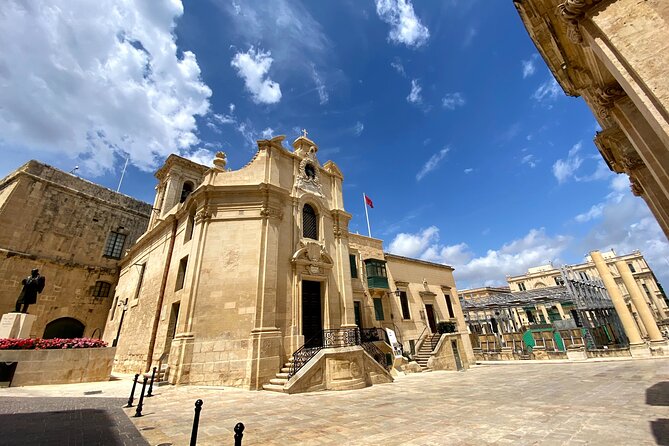
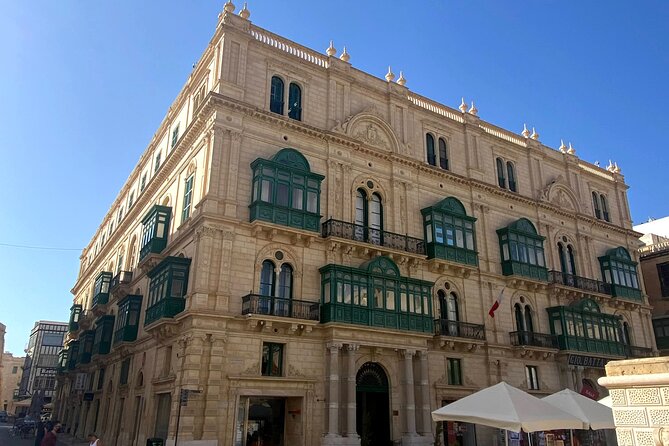
Palazzo Parisio adds another layer to Valletta’s story. Your guide explains which famous historical figure lived there, giving the building a personal connection beyond its façade. The stop is brief, but it helps turn a row of old stone buildings into a sequence of people and events.
St George Square is the city’s main open space and an easy place to appreciate Valletta’s formal design. You can expect an explanation of how the square and the surrounding buildings functioned through different periods. It is also a practical point for photos and a short pause.
The Grand Master’s Palace is one of the most important buildings on the route. Its role changed over the centuries, and your guide explains why it mattered under the Knights and in later government. Admission is not included, so an interior visit requires extra payment.
The palace stop illustrates why a private guide can be useful even when you do not go inside. A building like this can look impressive but vague without context. A clear explanation gives you something to look for if you decide to return later.
Strait Street, monuments, and the city’s human stories
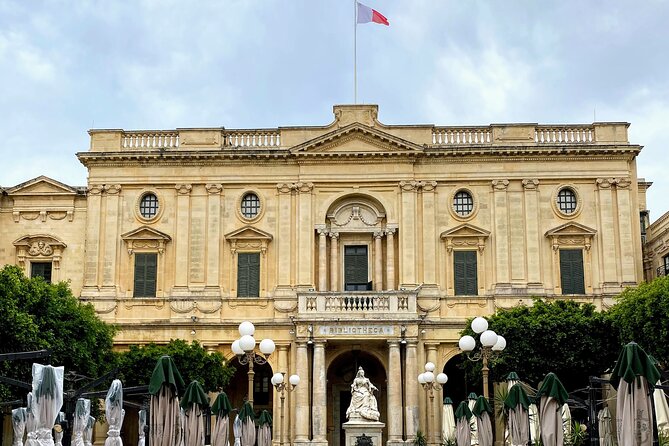
The tour also touches places such as Strait Street, the Great Siege Monument, Piazza Regina, the National Library of Malta, and the Church of St Paul’s Shipwreck. These stops keep the walk from becoming a simple list of grand buildings.
Strait Street is especially useful for seeing a more social side of old Valletta. The guide may connect it to the people who lived, worked, and spent time in the city rather than focusing only on rulers and military leaders. The Church of St Paul’s Shipwreck brings in one of Malta’s central religious traditions.
The storytelling is often strongest when it moves away from official monuments. You hear about patients at the Holy Infirmary, the difficult life of galley slaves, and whether every knight followed the vows expected of him. These details give you a less polished picture of the Order and make the city’s past easier to picture.
The Great Siege Monument and nearby memorials also provide a bridge between the medieval and modern periods. Malta’s story did not end with the knights. The walk connects the fortified city to later conflicts and to the country’s changing identity.
Lower Barrakka Gardens and the end near St George’s Square
The route ends at Lower Barrakka Gardens, with views toward the lower part of Valletta and the harbour area. Compared with Upper Barrakka, the setting feels more like a final lookout than a central scenic terrace.
Ending here is practical. You finish near St George’s Square and Republic Street, so you can continue exploring, find lunch, or return to a site that deserves more time. You do not finish at your hotel, since hotel pickup and drop-off are not included.
The two gardens also give the tour a pleasing shape. Upper Barrakka supplies the broad harbour view in the middle of the walk, while Lower Barrakka closes the route with another look at Valletta’s defensive setting.
How the private format affects the pace
The tour costs $362.95 per group of up to four. For four people, that is about $91 each. For two people, it is roughly $181.50 each, and for a solo participant, the full group price is a serious expense.
That price makes the most sense if you want an English-speaking guide focused only on your party. You are paying for personal attention, a flexible route, and the chance to ask questions throughout the walk. It is less attractive if you mainly want a quick orientation or are happy to read about the buildings yourself.
Most of the response to the guides has been very strong, especially for clear historical explanations, friendly manner, and flexibility. Mario is described as a former history teacher, while several guides, including Ian, Matthew, Carmel, Jennifer, Daniela, Raymond, Alizea, and Matteo, have received praise for their storytelling and local insight.
Guide quality can vary from person to person, so I would make your interests clear at the start. If you care most about architecture, ask for that focus. If you want military history, religious art, World War II, or restaurant advice, say so early.
One caution concerns breaks. Some guides include a short refreshment stop or take time at an artisan market. That can be welcome in Malta’s heat, and one person appreciated a break with practical advice about the rest of the city. But if you want every minute spent walking, state that clearly. One person felt a 20-minute break made the pace too slow and reduced the amount covered.
Timing, walking comfort, and admission costs
The tour lasts about three hours and includes steady walking through Valletta. The route is central and uses public streets, gardens, squares, and historic areas. Most people can participate, children must be with an adult, and service animals are allowed.
You should plan for warm conditions, especially if your tour falls in the afternoon. One person specifically recommended a morning start because Valletta can feel hot later in the day. Comfortable shoes and water are sensible choices, even though the tour is not described as strenuous.
Entry to three notable sites is extra: the museum connected with Auberge d’Italie, St John’s Co-Cathedral, and the Grand Master’s Palace. The tour can still work without entering all three, but you should budget for tickets if these interiors matter to you.
The service is offered in English and uses a mobile ticket. Confirmation arrives within 48 hours of booking, subject to availability. Free cancellation is available if you cancel at least 24 hours before the start time. Cancellations or changes inside that window do not receive a refund.
Who will get the most from this Valletta walk
I would choose this tour for a first visit, especially if you want to understand the city before exploring it alone. It gives you a usable framework for Valletta and points out places you might otherwise pass without noticing.
It also suits families and small groups who want to move at their own speed. A private guide can slow down for children, allow time for photos, or give more attention to a particular interest. The exact adjustment depends on the guide and the schedule, but the private format gives you a better chance than a large group tour.
It is a strong choice for people who enjoy historical storytelling more than a simple photo walk. The best parts are the links between buildings, military events, religious life, and ordinary people.
I would hesitate if you are traveling alone on a tight budget, want long interior visits, or prefer to cover every corner of the city at speed. Valletta is compact, and you can see more ground independently after learning the basic layout. The tour’s value lies in explanation and personal attention, not in sheer distance.
Should you book the Valletta Private Walking Tour?
Book it if you are a group of three or four, this is your first time in Valletta, and you want the city’s stones to make sense. The harbour views, major buildings, and human stories give you a solid first look, while guides such as Mario, Ian, Matthew, and Carmel are praised for making the past clear and entertaining.
Think twice if you are alone, watching every dollar, or unwilling to pay extra for cathedral and palace admission. If you do book, choose a morning start when possible, ask about the guide’s pace, and explain which subjects matter most to you. Done that way, the walk can give you a useful map of Valletta and a better reason to return to its interiors and side streets.
FAQ
How long is the Valletta Private Walking Tour?
The tour lasts approximately three hours.
How much does the private tour cost?
The listed price is $362.95 per group of up to four people.
What language is the tour offered in?
The tour is offered in English.
Where does the tour begin?
It begins at the New Parliament Building on Republic Street in Valletta.
Where does the tour end?
The tour ends at St George’s Square on Republic Street.
Are admission tickets included?
Admission is not included for the museum at Auberge d’Italie, St John’s Co-Cathedral, or the Grand Master’s Palace. The other listed stops are shown with free admission.
Is hotel pickup included?
No. Hotel pickup and drop-off are not included.
Can I cancel for a full refund?
Yes. You can cancel at least 24 hours before the local start time for a full refund. Cancellations or changes made less than 24 hours before the start time are not refunded.
Just added around Valletta
- Valletta: Private Maltese Cuisine Walking Tour★ 4.8 · 8 reviews
- Valletta: Private Massage from a world renowned masseuse★ 4.6 · 9 reviews
- Valletta: Guided Walking Tour★ 3.8 · 5 reviews
- Valletta : Highlights & Hidden Gems Walking Tour★ 3.1 · 5 reviews
- Valletta Aperol Spritz Aperitivo Experience★ 4.6 · 27 reviews
- Valletta: Express Walk with a Local in 60 minutes★ 4.9 · 4 reviews
- Valletta: Food and Culture Private Tour★ 4.9 · 10 reviews
- Valletta and 3 Cities Private 4-Hour Shore Excursion★ 4.7 · 11 reviews
Walking Tours in Valletta, compared.
Guided Walking Tour with Optional Cathedral Tour
Read our review →
The Valletta Street Food and Culture Walking Tour
Read our review →
Browse the lists this tour appears in