
Reviewed · WALKING TOURS IN VALLETTA
Valletta World War II Private Walking Tour
Malta’s WWII story comes alive in the places where it happened: the ruined Royal Opera House, the harbor-facing Siege Bell Memorial, old shelter areas, and the streets where daily life carried on under attack. I like the private format, which lets your guide adjust the pace and answer questions, and I like that the museum visit is guided rather than simply tacked on at the end. Matthew and Mario are both praised for their local knowledge and storytelling.
The main drawback is that this is a serious walking tour on hard stone, with hills and stairs. Three hours outside can also feel hot, so bring water, sun protection, and good shoes. The National War Museum ticket costs extra, and the meeting-point wording should be confirmed before you go.
Key points at a glance
- The Illustrious Blitz: Follow the story of repeated attacks on HMS Illustrious in Valletta during 1941.
- A city under siege: Learn how tunnels, Victory Kitchens, and harbor supply convoys helped civilians survive.
- The ruined Opera House: See the shell left by a 1942 German bombing raid.
- A guided museum visit: Spend about an hour at Fort St. Elmo’s National War Museum, with admission paid separately.
- Personal local stories: Guides including Matthew and Mario connect wartime events with Maltese family experiences.
- A true private tour: Only your group takes part, making the pace and questions more flexible.
Malta’s wartime story begins in Valletta
This tour focuses on Malta between 1940 and 1943, when the island became a key target in the struggle for control of the Mediterranean and North Africa. After Mussolini declared war in 1940, Malta became a base and obstacle that the Axis powers wanted to neutralize.
The aim was not only to bomb military targets. Malta’s ports, airfields, supply routes, and civilian population all came under pressure. The island endured repeated attacks and attempts to cut off food and other supplies. The result was one of the most intense bombing campaigns suffered by any place during the war.
I find this context useful because it gives Valletta’s grand streets a second layer. You are not simply looking at baroque buildings and harbor views. You are also seeing a city that had to keep functioning while aircraft attacked overhead, supplies ran short, and many residents relied on underground shelters.
Your guide explains this story while pointing out real locations. That is more effective than hearing a general lecture in a museum because the streets, harbor, and surviving damage help fix the events in your mind.
More Walking Tours in Valletta
- The Original Valletta Walking Tour
★ 5.0 · 2,719 reviews - Valletta: 3-Hour Walking Tour
★ 4.7 · 1,605 reviews - Valletta: Guided City Walking Tour
★ 4.8 · 1,256 reviews
Starting near Valletta’s city gates
The walk begins in central Valletta, with the published meeting information identifying Victoria Gate and the itinerary referring to Valletta City Gate. Some tour details also describe meeting near the Upper Barrakka Gardens. Since these are separate landmarks in central Valletta, check the exact meeting point on your confirmation before setting out.
This is especially important if you are arriving from a cruise ship or using a taxi. The city is compact, but its gateways and upper and lower streets can lead you in different directions. One family used the tour during an eight-hour cruise stop and found the walk from the ship manageable, but you still want to allow time to locate your guide.
The opening minutes are not the main event. They get your bearings and introduce the city as a wartime target. From there, your guide leads you through Valletta’s streets toward the harbor and the sites tied to the siege.
The Royal Opera House and the visible scars of bombing
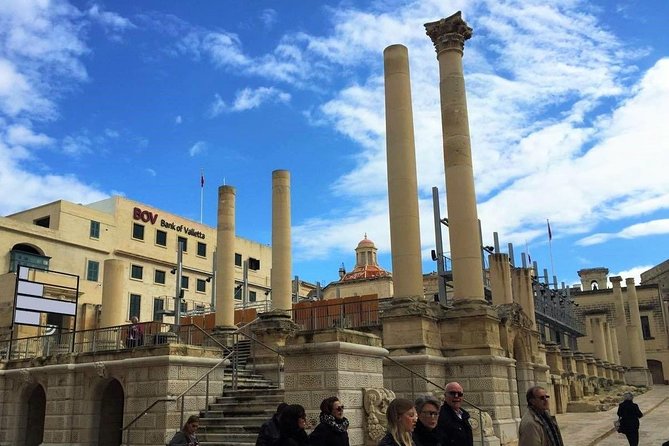
One of the most memorable stops is the ruined shell of the Royal Opera House. A German bombing raid destroyed it in 1942, leaving the remains as a powerful reminder that the wartime damage was not confined to military installations.
The site also helps explain how Valletta has changed since the war. The ruined structure sits in the middle of the modern city, where daily activity continues around it. I like this kind of stop because it needs little decoration. The damage itself does the work.
Your guide also points out commemorative statues and memorials connected with Malta’s wartime experience. The tour is not built around a long list of intact monuments. In fact, one useful expectation to set is that the downtown area has fewer obvious WWII sights than you might imagine. Much of the value comes from the explanation of what happened at each place, not from dramatic ruins at every corner.
That makes the guide important. A self-guided walk could take you past the Opera House and memorials without showing how they fit into the wider siege.
The Siege Bell above Grand Harbour
The Siege Bell Memorial is one of the tour’s strongest visual stops. It overlooks Grand Harbour and honors those affected by the siege. From here, your guide can connect Valletta’s position, the harbor, and the need to protect shipping routes.
The harbor is central to Malta’s wartime story. The island needed supplies, but bringing them in meant sending convoys through waters threatened by Axis aircraft and submarines. The San Marija Convoy is one of the events discussed during the walk, along with the wider struggle to keep Malta supplied.
This is where the tour moves beyond a simple account of bombing. Malta’s survival depended on food, fuel, ammunition, ships, and timing. The story is as much about keeping a small island alive as it is about defending stone fortifications.
The Siege Bell also gives you a pause from the narrower streets. Much of the walk takes place on stone paving and through built-up areas, so the open harbor view offers a welcome change. Bring water, especially in warm weather, since the tour spends most of its time outdoors.
Same islands, a completely different kind of day:
- Valletta: Street Food and Culture Walking Tour
★ 4.8 · 1,251 reviews - Valletta: City Walking Tour in a Small Group
★ 4.9 · 957 reviews - From Sliema: Valletta and the Three Cities Scenic Cruise
★ 4.3 · 763 reviews - Valletta: Guided Walking Tour with Optional Cathedral Tour
★ 4.3 · 758 reviews
Tunnels, shelters, and the Victory Kitchens
One of the most useful parts of the experience is learning how civilians managed everyday life. Valletta’s tunnels provided shelter during air raids, while Victory Kitchens were established to feed people when normal supplies and cooking arrangements were disrupted.
These details make the war personal. Military dates and battles can seem distant, but sheltering underground and finding a meal are easy to understand. Your guide explains how people tried to maintain some routine while bombardments repeatedly interrupted life.
The tour does not promise entry into every wartime tunnel. Its focus is on the sites and stories encountered during the walk, with the National War Museum visit providing the main indoor section. If you specifically want to go inside underground wartime headquarters, one visitor suggested adding the Lascaris War Rooms separately. That is useful planning advice, since this tour should not be treated as a complete tour of every WWII site in Valletta.
I particularly like that the guide connects civilian survival with the broader military campaign. The shelters and kitchens were not side notes. They show why Malta’s resistance was also a community effort.
The Illustrious Blitz and the Battle of Grand Harbour
The tour covers major events including the Battle of Grand Harbour and the Illustrious Blitz. In 1941, Axis forces repeatedly attacked HMS Illustrious, an aircraft carrier in Valletta, making the harbor and the surrounding city a repeated target.
Your guide explains these events at the locations that shaped them, adding dates and sequence to the story. Matthew is praised for recalling precise days and years, while Mario is described as a retired Maltese history teacher with family connections to wartime life. The guide you receive may vary, but the experience is clearly intended for people who want more than a broad outline.
The private setting helps here. You can ask about the Royal Navy, the Knights of Malta, Malta’s role in North Africa, or a family connection to the island without worrying about holding up a large group. One person whose father served in the Royal Navy found the personal connection especially meaningful, and the guide was able to add context to those memories.
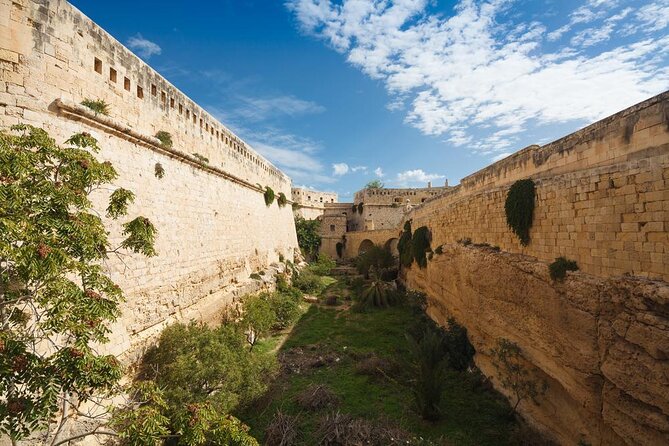
The tour also gives some background reaching back to the 1500s and the Knights of Malta. That material is not the main subject, but it helps explain why Valletta was fortified and why its harbor mattered long before WWII.
Fort St. Elmo and the National War Museum
The walk finishes at Fort St. Elmo, home of the National War Museum. The museum visit takes about an hour and is the only major admission cost not included in the tour price.
You see displays and audiovisual material about Malta’s wartime ordeal, including the problem of bringing supplies to the island. The 1942 George Cross awarded to Malta’s population is another major object. It recognizes the courage shown during the bombing and siege.
The museum matters because it gathers the scattered pieces of the walking tour in one place. After seeing the harbor and city streets, you can place uniforms, equipment, documents, and wartime objects into a clearer sequence.
I would not rush away at the end. Several people found Fort St. Elmo’s museum one of the strongest parts of their time in Malta, and the guide’s presence made the visit more useful. Matthew and Mario are both praised for walking through the museum and focusing on the important exhibits rather than sending the group in alone.
The museum ends the tour in a practical location near other Valletta sights. Since the scheduled experience finishes at Fort St. Elmo, you can continue with nearby attractions if your schedule allows. The tour itself does not include admission to other museums or sites.
What the private format is worth
The listed price is $373.48 for a group of up to four people. For four people, that works out to about $93 per person. For two people, it is about $187 each, so the value depends heavily on your group size and how much you want personal attention.
For a history-focused private tour, the price buys more than a route between landmarks. You get an English-speaking professional guide, a flexible conversation, and a guided museum visit. If you are traveling as a family or small group with a strong interest in WWII, the ability to ask detailed questions can make the cost reasonable.
For a solo visitor, the same group price is a much tougher calculation. I would choose it mainly if Malta’s WWII story is a central reason for your visit, or if you want a private guide rather than a general city walk.
The experience has a rating of 4.8 from 26 reviews, with 96 percent recommending it. The strongest praise centers on the guides’ passion, clear storytelling, local background, and willingness to walk through the museum with the group. That pattern matters because the route itself is not packed with spectacular interiors. The guide is a major part of what you are paying for.
Pace, footwear, and practical planning
Treat this as an active walk, not a gentle sightseeing stroll. The route covers hard stone streets and includes uphill sections and stairs. You should have moderate physical fitness and wear shoes that work well on uneven paving.
Bring:
- Water
- Sun protection
- Comfortable walking shoes
- Extra time if you want to continue exploring Fort St. Elmo afterward
The tour lasts about three hours, with roughly one hour spent at the National War Museum. The rest is outside, so weather and heat can affect your comfort. Breaks are possible with a private guide, and one guide was specifically praised for keeping a gentle pace and stopping to discuss interesting locations.
Hotel pickup and drop-off are not included. The tour is near public transportation, but you need to make your own way to the central Valletta meeting point and away from Fort St. Elmo afterward.
The activity is non-refundable and cannot be changed after booking. Because confirmation is subject to availability and can arrive within 48 hours, I would avoid booking it too close to a tightly scheduled cruise departure or other fixed activity.
Who should book this Valletta WWII walk?
I would choose this tour if you want Malta’s wartime story explained by someone who can connect military events with civilian life. It suits history lovers, families with older children, former service members, and anyone with a personal connection to Malta or the Royal Navy.
It also works well for a short stay. A three-hour route gives you a clear introduction to Valletta’s role in WWII without requiring a full day. Cruise passengers can use it during a long port stop, provided they leave enough time for the return to the ship.
I would be more cautious if you dislike walking, struggle with hills and stairs, or mainly want to see lavish interiors and famous architecture. The tour is about interpretation and place, not a parade of grand rooms. You should also plan an extra cost for the museum ticket.
Should you book it?
Book this private walk if you want a focused, human account of Malta during the Siege, complete with harbor views, bombing sites, civilian survival stories, and a guided visit to Fort St. Elmo’s museum. Matthew and Mario are especially strong names to request if the booking process allows, though guide assignment is not guaranteed.
I would call it good value for a group of four with a real interest in WWII. Couples should weigh the higher per-person cost, but the personal attention can be worthwhile if you prefer asking questions and setting your own pace. Pack water, wear sensible shoes, confirm the exact meeting point, and leave time for the museum. If you do that, this is a focused way to understand why Valletta’s wartime story still shapes the city.
FAQ
How long is the Valletta World War II Private Walking Tour?
The tour lasts approximately three hours.
Where does the tour start?
The tour starts in central Valletta. The supplied meeting information identifies Victoria Gate, while the itinerary refers to Valletta City Gate. Confirm the precise meeting point before the tour.
Where does the tour finish?
The tour finishes at Fort St. Elmo and the National War Museum on Mediterranean Street in Valletta.
Is the National War Museum ticket included?
No. Admission to the National War Museum is not included and must be paid separately.
Is the tour private?
Yes. Only your group participates, with a maximum of four people at the listed group price.
What language is the tour offered in?
The tour is offered in English.
Is the tour suitable for people with limited mobility?
The tour requires a moderate level of physical fitness. Expect a lot of walking on hard stone, uphill sections, and some stairs.
Just added around Valletta
- Valletta: Private Maltese Cuisine Walking Tour★ 4.8 · 8 reviews
- Valletta: Private Massage from a world renowned masseuse★ 4.6 · 9 reviews
- Valletta: Guided Walking Tour★ 3.8 · 5 reviews
- Valletta : Highlights & Hidden Gems Walking Tour★ 3.1 · 5 reviews
- Valletta Aperol Spritz Aperitivo Experience★ 4.6 · 27 reviews
- Valletta: Express Walk with a Local in 60 minutes★ 4.9 · 4 reviews
- Valletta: Food and Culture Private Tour★ 4.9 · 10 reviews
- Valletta and 3 Cities Private 4-Hour Shore Excursion★ 4.7 · 11 reviews
Walking Tours in Valletta, compared.
Guided Walking Tour with Optional Cathedral Tour
Read our review →
The Valletta Street Food and Culture Walking Tour
Read our review →
Browse the lists this tour appears in