
Reviewed · MALTA ATTRACTION PASSES
Heritage Pass in Malta
Malta’s past comes at you in layers: Neolithic temples, Roman houses, underground Christian tombs, and forts built when the island faced Ottoman attack. This pass ties many of those places to hop-on hop-off buses and two boat trips, giving you a useful first look at Malta without buying every ticket separately.
I like the freedom to mix Valletta with Mdina, Birgu, the southern temples, and Gozo-related routes. I also like the harbor cruise, which gives you a clear view of the forts from the water, and the free Wi-Fi on both cruises.
The catch is that this is not a magic key to Malta. You must plan around opening hours, bus routes, and long travel times, and the advertised three-day period conflicts with provider replies that describe a six-day validity period. Confirm the terms printed on your pass before you build your schedule.
Key points to know before you buy
- Sixteen named sites are detailed here: The pass is promoted as covering more than 20 attractions, but the supplied stop list names 16. Ask for the current attraction list before paying.
- Two major bus routes are useful but slow: A full route can take up to six hours, according to the information supplied by a passenger, so do not treat the buses like quick city transport.
- The strongest sites cover several eras: Fort St. Elmo, Ħaġar Qim, St. Paul’s Catacombs, and the Domvs Romana each tell a very different story.
- Site access depends on opening times: Scan the QR code for the current hours, especially before traveling across the island for a single museum or archaeological site.
- Personal help can make the pass work better: Sales staff named Diane Zammit, Sandra Fenech, Monalisa, Gabriela, Giancarlo, and Allen were praised for explaining routes and choices.
- The price only pays off with active use: At $92.69 per person, you need several admissions plus transport and cruises to beat paying for individual visits.
What this Malta pass really gives you
At its best, the Heritage Pass is a transport-and-sightseeing package for a history-heavy trip. You get access to a broad set of Heritage Malta locations, unlimited use of the hop-on hop-off bus during the valid period, a Valletta and Three Cities harbor cruise, and a coastal route toward Comino and Gozo.
That mix matters because Malta’s sights are spread across the island. Valletta is compact, but Ħaġar Qim is on the southern coast, the prehistoric sites near Mġarr sit away from the capital, and St. Paul’s Catacombs and the Domvs Romana are in or near Rabat and Mdina. A pass can reduce the hassle of arranging every connection yourself.
The supplied information calls the experience three days and prices it at $92.69 per person. Yet provider replies included with the booking information describe the Heritage Pass as valid for six days. That is not a minor detail. A three-day pass demands a tight schedule, while six days gives you room to spread out the museums and temples. Check the validity printed on your confirmation or ask the seller directly.
The attraction count also needs care. The pass is described as covering more than 20 sites, while the supplied schedule names 16 stops. That may reflect a wider current network, a changing list, or a product variation. Before you buy, ask which places are included now and which require a separate ticket.
More Malta attraction passes:
- Malta Multi Pass
★ 3.6 · 164 reviews - Gozo Day Pass Ferry and Hop-on Hop-off buses with audio Tour
★ 3.0 · 19 reviews - From Sliema or Bugibba: Gozo Heritage Day Pass
★ 3.0 · 16 reviews
Valletta’s forts, art, and military story
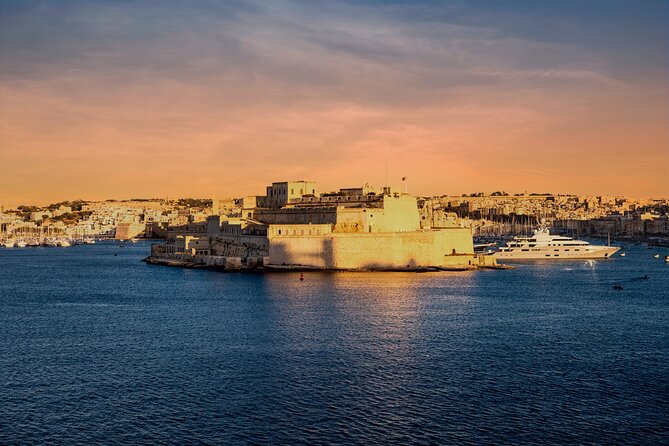
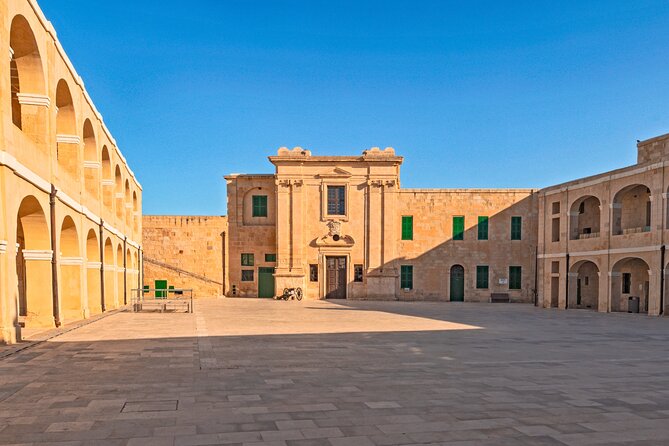
Start in Valletta with Fort St. Elmo and the National War Museum. The star-shaped fort occupies the tip of the Sciberras Peninsula, between Marsamxett Harbour and Grand Harbour. Its position explains its importance better than a map alone: it helped control the entrances to both harbors.
The fort is closely linked with the Great Siege of 1565, when the Knights of St. John faced an Ottoman assault. Give yourself about an hour. The setting is as important as the displays, since you can connect the walls, harbor entrances, and defensive design while walking through the site.
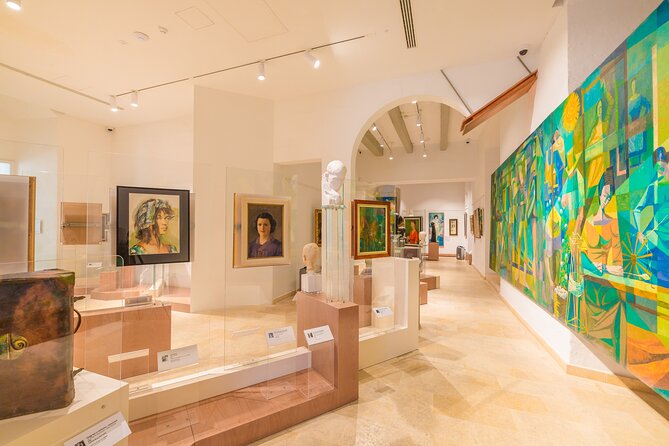
MUŻA, the Malta National Community Art Museum, offers a change of pace. Housed in the Auberge d’Italie, it presents Maltese and foreign art across major European styles. The collection was formerly shown at Admiralty House before moving to its current Valletta home.
Allow another hour. This is a good stop when you want paintings and decorative art between military sites. It also helps you see Malta as more than a fortress island. The possible drawback is practical: if your day is already crowded with major archaeological sites, MUŻA may be easier to skip than Fort St. Elmo or the temples.
The State Rooms in the Presidential Palace are another Valletta highlight. The palace began as one of the first buildings in the new city after 1566 and grew under successive Grand Masters. It later served as the Governor’s Palace and housed Malta’s first constitutional parliament in 1921.
The rooms can close at short notice by presidential order. Treat this as a bonus stop, not the one sight around which you build your whole day.
The Palace Armoury fills in the military picture. You can see armor linked with Grand Masters Alof de Wignacourt and Jean de Valette, Ottoman armor and weapons, and artillery pieces. Together, the armoury and Fort St. Elmo explain how the Order of St. John presented power, faith, and defense.
Birgu and the Grand Harbour
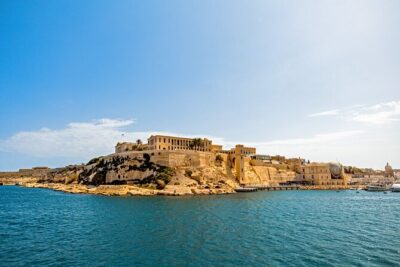
Cross to Birgu for Fort St. Angelo and the Malta Maritime Museum. Fort St. Angelo began as the medieval Castrum Maris, then became a fortified headquarters of the Order of St. John during the Great Siege. Its later reconstruction in the 1690s gave it much of its present form.
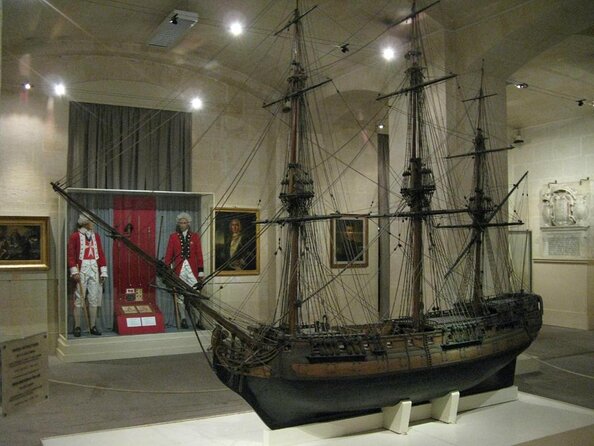
This is a fine place to use the pass slowly. The fort sits at the center of Grand Harbour, so it gives you a different angle on Valletta and the harbor defenses. Pair it with the maritime museum, housed in a former Royal Naval Bakery built in the 1840s for the Mediterranean Fleet.
The museum covers Malta’s maritime story from prehistory to the present and includes more than 20,000 objects. I would choose it if you want ships, naval power, trade, and daily life at sea rather than another set of stone walls.
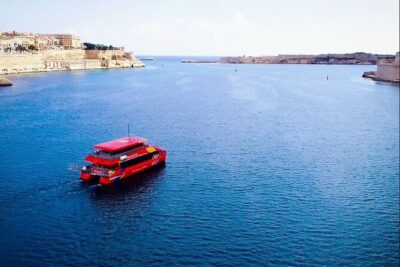
The harbor cruise helps connect these sites. From the water, Valletta, Birgu, Senglea, and the harbor forts make better sense as a defensive system. Both listed cruises include free Wi-Fi, a small but useful perk if you want to check schedules or share photos while aboard.
The bus can be less simple than the brochure makes it sound. Two routes cover the island, and a complete route may take up to six hours. Stop locations can also be confusing after you get off, especially around Valletta Waterfront. Save the route map and note the stop name before leaving the bus.
One passenger described the buses as a good way to see much of Malta but had trouble locating the correct stop after getting off. Another reported a missed pickup in the north. I would build in extra time and avoid planning a timed museum entry immediately after a bus connection.
Mdina, Rabat, and the underground world
The National Museum of Natural History is in Mdina’s Palazzo Vilhena, a French Baroque palace rebuilt in 1726. It gives you an overview of Malta’s ecosystems, both on land and underwater, with displays of minerals, fossils, insects, reptiles, birds, mammals, fish, geology, and paleontology.
Look for references to local species such as the Maltese centaury and the Blue Rock Thrush. This is a useful one-hour stop for families or anyone who wants scientific context before visiting ancient sites.
Nearby, the Domvs Romana focuses on private life in Roman Malta. The house itself is only partly preserved, but its mosaics and surviving objects show the wealth of the original residence. The visit is short enough to fit between Mdina and Rabat sights, and it adds a domestic scale to Malta’s story.
St. Paul’s Catacombs offers a sharper contrast. The underground galleries and tombs date from the third to the eighth centuries CE. More than 30 hypogea form the wider St. Paul’s and St. Agatha’s complex, with over 20 open to the public.
This is one of the pass’s more distinctive inclusions. You are not just looking at a grand building. You are walking through burial spaces cut into the ground, where the layout tells you about early Christian customs and the use of underground chambers.
Allow about an hour, and confirm the opening time before taking the bus. A reported problem involved a passenger reaching the catacombs but being unable to enter with the pass. The provider’s response emphasized checking the QR code for site hours. That advice is worth following, but I would also confirm at the entrance that your particular pass is accepted.
More History Tours in Malta:
- Malta: Prehistoric Temples, Limestone Heritage & Blue Grotto
★ 4.2 · 412 reviews - Maltese Islands History Audio-Visual Show and La Sacra Infermeria Tour
★ 4.0 · 344 reviews - Valletta: Self-Guided Historical Walking Tour (Audio Guide)
★ 3.7 · 251 reviews - Wonderful Valletta, gastronomy, art, and history in the Mediterranean
★ 4.5 · 72 reviews
The oldest temples on Malta
The prehistoric sites are the pass’s biggest reason to appeal to archaeology fans. Ta’ Ħaġrat, near Mġarr, includes two temples. The larger dates to the Ġgantija phase, roughly 3600 to 3200 BCE, while the smaller belongs to the Saflieni phase, about 3300 to 3000 BCE.
Skorba Temples, near Żebbiegħ, also helps explain Malta’s earliest Neolithic culture. The remains are less visually grand than some other sites, but their value lies in what they reveal about early settlement and temple building. Skorba is part of the UNESCO-listed group of Maltese megalithic temples.
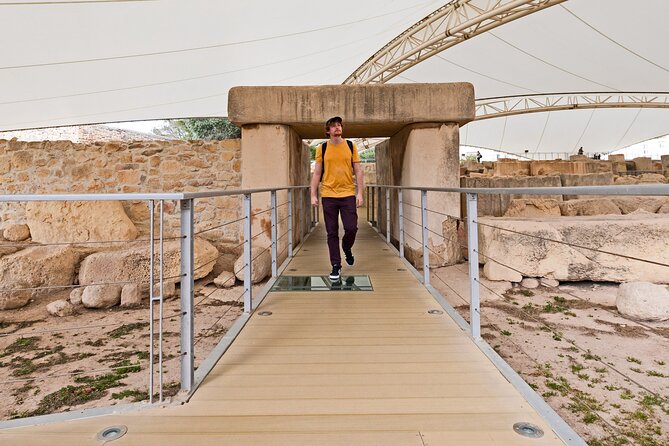
At the southern edge of the island, Ħaġar Qim and Mnajdra form a powerful pair. Ħaġar Qim sits on a ridge of globigerina limestone, the rock used by the builders. Mnajdra is about 497 meters away, so the two sites can be treated as one outing.
The temples date from the fourth millennium BCE, making them among the oldest religious sites on earth. A protective tent was completed over Mnajdra in 2009. The shelter may change the feel of the setting, but it helps protect the ancient stones from Malta’s strong sun and weather.
Do not rush this visit. The sites are far enough from Valletta that transport takes time, and the value comes from understanding the age, materials, and setting. If you have only three active days, place Ħaġar Qim and Mnajdra high on your list and treat Ta’ Ħaġrat or Skorba as optional additions.
The Tarxien Prehistoric Complex gives you another view of temple design. It includes three attached temple structures, with decoration that makes it one of Malta’s most elaborate prehistoric sites. Some carved slabs were moved to the Archaeology Museum in Valletta for protection, so the site and the museum work well together.
Għar Dalam Cave and Museum takes you farther back in a different way. The cave is a 144-meter phreatic passage containing animal bones from species that became extinct in Malta at the end of the last glacial period. Pottery found here also connects the cave to Malta’s early human settlement.
Borġ in-Nadur combines a Tarxien-period megalithic temple with a Bronze Age village and Malta’s earliest known fortification. The open setting near St. George’s Bay also places later features nearby, including Bronze Age cart ruts, silos, a Roman villa, and a much later redoubt.
These smaller archaeological sites reward curiosity, but they may not have the same immediate impact as Ħaġar Qim or Mnajdra. If time is tight, use them to fill gaps rather than forcing all of them into one exhausting day.
How to plan three days without racing
If the pass truly lasts three days, group sights by area.
Day one: Valletta and the harbor. Visit Fort St. Elmo, MUŻA, the State Rooms, and the Palace Armoury. Add the Valletta and Three Cities harbor cruise if the sailing time fits. Do not try to visit every museum in one sweep. Choose two or three, then enjoy the city streets and harbor views.
Day two: Mdina, Rabat, and nearby archaeology. Combine the Natural History Museum, Domvs Romana, and St. Paul’s Catacombs. Add Ta’ Ħaġrat if transport and opening hours line up. This is a better day for smaller indoor visits than for a long southern-coast excursion.
Day three: southern temples and Birżebbuġa. Make Ħaġar Qim and Mnajdra the main event. If you still have time, consider Għar Dalam or Borġ in-Nadur. Tarxien can fit on this day, but the exact order depends on bus timing.
The hop-on hop-off route and the coastal service toward Comino and Gozo can also reshape the plan. Use them for broad sightseeing, not precision connections. If the pass is actually valid for six days, slow down and separate Valletta, the Three Cities, Mdina, and the southern temples.
Is $92.69 good value?
At $92.69 per person, the pass is not automatically a bargain. Its value depends on four things: how many included sites you visit, how often you use the buses, and whether you take both cruises and the coastal route.
The pass makes more sense if you want several museums and archaeological sites, not just one or two headline attractions. It also becomes more useful if you are staying in an area where the hop-on hop-off service saves you from arranging multiple journeys.
Paying as you go may be better for a light schedule. The individual entry fees are described as relatively inexpensive, and one practical criticism was that you need to visit many places to reach the pass’s value. Do the math before booking: count the sites you genuinely want, then add the price of comparable transport and cruises.
The pass is also more attractive for an organized history trip than for a relaxed beach break. You can spend several hours on buses and still have museums to visit. That is a fair trade if you enjoy forts, temples, collections, and underground archaeology. It is poor value if you dislike fixed routes or plan to spend most of your time by the sea.
Who will enjoy this most?
I would recommend the pass to a first-time Malta visitor who wants a broad introduction and is willing to plan each day. It suits history fans, museum lovers, families with older children, and anyone who likes seeing a place through several periods rather than sticking to one town.
It is less suitable if you want a slow holiday, dislike buses, or have only a few free hours. The route problems and site closures are not deal breakers, but they mean you must stay alert.
Helpful staff can make a real difference. Diane Zammit, Sandra Fenech, Monalisa, Gabriela, Giancarlo, and Allen were all identified as people who gave detailed explanations or helped match the pass to a schedule. If you buy in person, ask the representative to mark the best bus stops, cruise times, and sites for your priorities. James, named as a ticket inspector, was also associated with the bus service.
You can cancel for a full refund up to 24 hours before the start time. Changes or cancellations within 24 hours are not refunded, and poor weather may lead to a new date or a full refund.
Should you book the Heritage Pass?
Book it if you will visit at least several included sites and want the buses and cruises as part of the same plan. The best case is a six-day validity period, because that gives you time to see Valletta, Birgu, Mdina, the catacombs, and the prehistoric temples without racing.
Pause before buying if the seller cannot clearly explain the validity period, attraction list, and current opening hours. The three-day versus six-day difference matters, as does the gap between more than 20 advertised attractions and the 16 named stops supplied here.
My practical call: good for an active, history-focused Malta visit, but only after you verify the terms and map your days. Use the QR code, keep route times flexible, and do not assume every site is open just because it appears on the pass.
FAQ
How long is the Heritage Pass valid?
The experience is presented as a three-day pass, but provider information also describes a six-day validity period. Check the terms on your confirmation or ask the seller before booking.
What is included in the pass?
It includes access to more than 20 advertised attractions, Heritage sites named in the current attraction list, unlimited hop-on hop-off bus use during the valid period, a Valletta and Three Cities harbor cruise, and a coastal route toward Comino and Gozo.
Which major attractions are included?
Named sites include Fort St. Elmo, MUŻA, the National Museum of Natural History, Ta’ Ħaġrat, Għar Dalam, Fort St. Angelo, the Malta Maritime Museum, Ħaġar Qim, the State Rooms, the Palace Armoury, Skorba, Borġ in-Nadur, St. Paul’s Catacombs, the Domvs Romana, Tarxien, and Mnajdra.
Does the pass include hop-on hop-off buses?
Yes. The pass includes unlimited use of the hop-on hop-off bus during its valid period.
Are cruises included?
Yes. The pass includes a Valletta and Three Cities harbor cruise and a coastal route toward Comino and Gozo. Free Wi-Fi is available on both cruises.
How can I check if a site is open?
Scan the QR code connected with the pass to check each attraction’s opening hours. This is especially important for sites that may close or have limited visiting times.
Can the State Rooms close unexpectedly?
Yes. The State Rooms can close at short notice by order of the President.
Can I cancel for a refund?
You can receive a full refund if you cancel at least 24 hours before the experience start time. Cancellations or changes made within 24 hours are not refunded. If poor weather cancels the experience, you are offered another date or a full refund.
Just added around Malta
- Gozo: Wine Tasting and Paired Dinner Experience★ 4.9 · 43 reviews
- World War II Malta Full-Day Walking Tour★ 4.3 · 18 reviews
- Victoria, Gozo: Sunset Walking Food and Drink Tour★ 5.0 · 6 reviews
- Malta: 5 hr Vintage Bus Tour – Mdina & Blue Grotto inc. food★ 5.0 · 22 reviews
- Wakeboarding Adventure in Malta: Learn to Ride★ 5.0 · 4 reviews
- Valletta: Private Massage from a world renowned masseuse★ 4.6 · 9 reviews
- Valletta & Mdina: Private Tour★ 4.5 · 16 reviews
- Valletta: Private Maltese Cuisine Walking Tour★ 4.8 · 8 reviews
Malta Attraction Passes, compared.

Gozo Day Pass Ferry and Hop-on Hop-off buses with audio Tour
Read our review →
COMBO: Heritage Pass with Hop-On Hop-Off Bus (CMO)
Read our review →Browse the lists this tour appears in